Anthony Hill’s Newsletter
Winter 2025

Dear friends
Welcome to my Winter 2025 Newsletter. In this edition:
• Soldier Boy play success
• Reviews
• The learning curve
• Tribute
• Melbourne International Film Festival
• Acting edition
Soldier Boy Play success
It’s a great joy for me to report that my Soldier Boy play had a successful debut at Theatre Works in Melbourne, and finished in July to very positive reviews – some superlatively so – and an emotional audience response.
Opening night on 21 June was an absolute buzz. Jim Martin’s great nephew Ian Cruwys was there, and John Harris, another great nephew, was unfortunately prevented by weather and stock needs. Julie Watts, who first published the book with Penguin, was present, and editor Suzanne Wilson flew in especially from New Zealand. I know all were profoundly moved by the play.
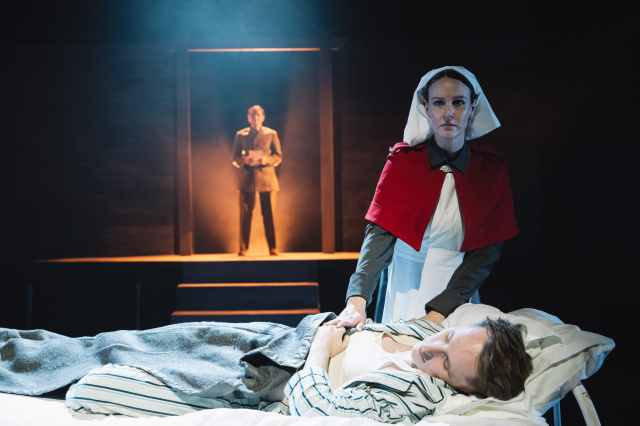
“Dear Mrs Martin…”
Ashlynn Parigi as Cec, Emily Joy as Matron Reddock, Oliver Tapp as Jim
Photo Steven Mitchell Wright, Theatre Works 2025
The production was directed by Beng Oh who bought great sensitivity and understanding to the text. The spare, almost abstract staging, lighting and sound effects underpinned the idea that the whole action was taking place in Jim Martin’s disordered mind as he lay dying of typhoid on a hospital ship off Gallipoli in 1915.
In this, I cannot praise highly enough the wonderful troupe of eight actors, led by Oliver Tapp and my cousin Laura Iris Hill, who bought the words so beautifully and with such deep human understanding to life.
They were supported in a way that surpassed my every expectation in multiple roles by Philip Hayden, Emily Joy, Ashlynn Parigi, Marc Opitz, Charlie Veitch and Mark Yeates. Their professionalism and ability to portray so many varied characters (and genders) was a delight to watch. To which I hasten to mention our assistant director Jessica Fallico and stage manager Ella Thompson, who held us all together.
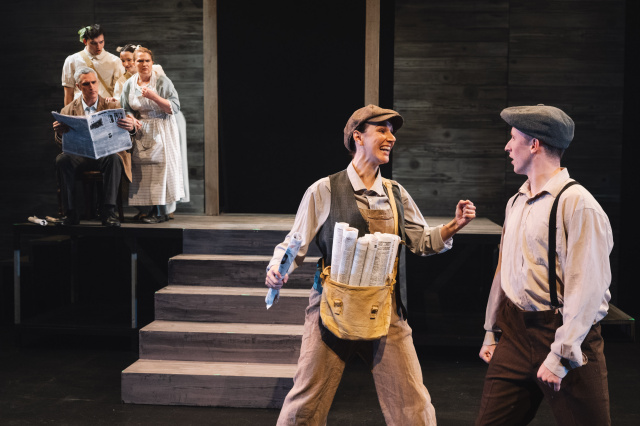
Outbreak of War, August 1914
Emily Joy as the newsboy with Oliver Tapp. Rear: Philip Hayden, Charlie Veitch, Ashlynn Parigi, Laura Iris Hill as Jim’s family.
Photo Steven Mitchell Wright, Theatre Works 2025
Without exception they welcomed me into the rehearsal room and their company, allowing me to be part of the extraordinarily collaborative process of developing a play for the stage – so very different from the solitary habit of a novelist – and have become fast friends. I now know where to turn when it comes to preparing my next work.
In saying this, I also embrace those very fine professionals who supported our production with their own theatrical skills. Jack Burmeister virtually wrote a soundtrack of music and special effects for the whole play.
Sidney Younger’s evocative lighting, and Vivienne Hargreaves’ sparse set, with its entrance reminiscent of a Japanese torii gate through which Jim passes from this life to the spirit realm, enhanced what one critic called “a heartbreakingly real yet poetically heightened” world. To which Adrienne Chisholm’s costume designs anchored the show to an historical time and place. Other crew to thank are : assistant stage manager Kade Lightfoot, Arianna Marchiori marketing, Jade Hibbert producing co-ordinator and Eleanor Howlett’s excellent publicity campaign.
And in all of this we were constantly supported by producer Dianne Toulson and her skilled and experienced people at Theatre Works. I thank them from my heart.
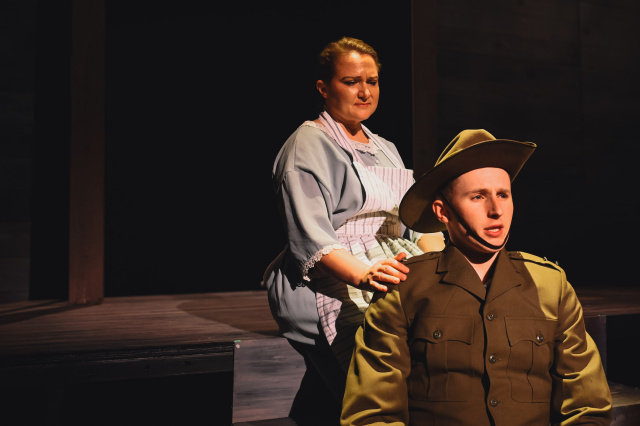
Mother and Son
Laura Iris Hill, Oliver Tapp. Photo Steven Mitchell Wright, Theatre Works 2025
Two years ago Laura took me to meet Belle Hansen, who showed us around the splendid playing space at the venue in Acland Street St Kilda, with its marvellous lighting and sound equipment. I remember thinking at the time how grand it would be if Soldier Boy ever managed to get staged there.
Well, it was Belle who took my script on board, ushered it through the VCE process and, when it was put on this year‘s playlist, arranged to have it performed at Theatre Works. I have a great debt of gratitude to the independent theatre and, if things go well, I hope we may be associated again another time.
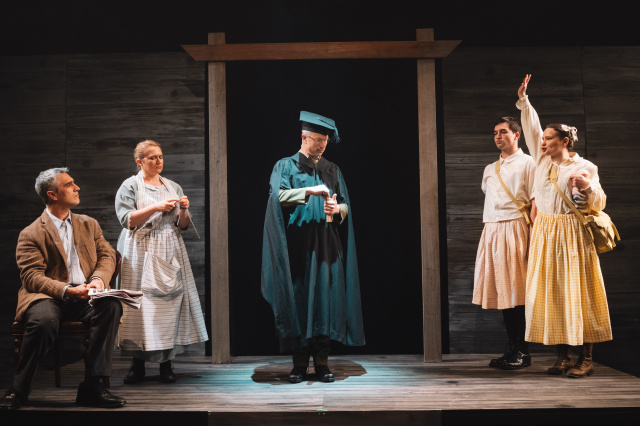
“Boy soldiers everywhere…”
Philip Hayden, Laura Iris Hill, Marc Opitz, Charlie Veitch, Ashlynn Parigi
Photo Steven Mitchell Wright, Theatre Works 2025
As a child I was stagestruck at the age of three and for a time wanted to be an actor, until I realised I really wanted to write the words the actors spoke. As a novelist, I supposed, one can have the best of both worlds, in that every story acts itself out on the stage we all have just behind the middle of the forehead.
But I realised during the run up to Soldier Boy that it was nothing like the real thing. To see the portent of my flimsy words on the page transform into a living, dying reality through the magic of the theatre took me into another dimension.
This has been one of the more important experiences of my life – so much so that I’ve been unable to write very much about it until now. Internally, my mind is still trying to comprehend the significance of the occasion to myself as a writer and artist.
But one thing I do know. With the draft of the companion play, Young Digger, waiting to come out of the drawer and onto the desk, I trust it will not be the last.
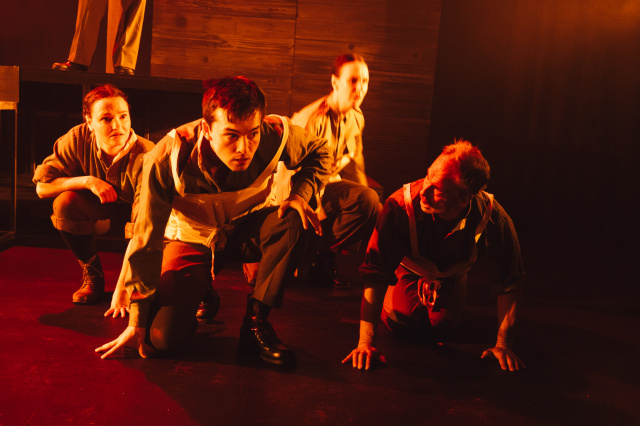
‘Torpedo!”
Ashlynn Parigi, Charlie Veitch, Emily Joy, Marc Opitz, Laura Iris Hill, Oliver Tapp
Photo Steven Mitchell Wright, Theatre Works 2025
Reviews
As mentioned, the reviews of the Soldier Boy production have been extremely positive – some quite remarkably so.
For example Australian Arts Review described the play as “a living breathing elegy to lost youth, to courage in its most fragile form, and to the aching cost of sacrifice.”
Beng’s direction, it went on, was “thoughtful and restrained, allowing the raw power of the story to shine through without sentimentality.”
ArtsHub got to the point of the story’s continuing relevance to us all. “At a time when there are multiple major conflicts around the world, Soldier Boy is a compelling and heart-wrenching production and a timely reminder of the many victims of war.”
Stage Whispers drew attention to one of Beng’s most remarkable stagings. During the scene where Jim emotionally blackmails his parents into signing a consent letter, the central argument was repeated in a loop four times, each becoming more angry and desperate. “Of course Jim remembers that – the fatal turning point in the story.”
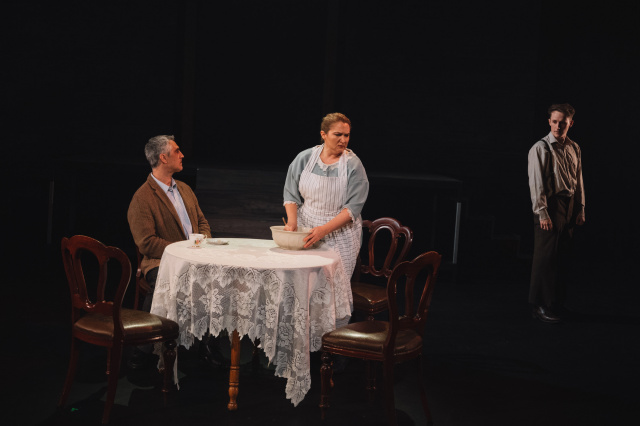
“Bring me a sheet of paper Jim, and a pen…”
Philip Hayden, Laura Iris Hill, Oliver Tapp
Photo Steven Mitchell Wright, Theatre Works 2025
And The Blurb added: “While deliberately focusing on Private Martin, Anthony Hill has crafted a powerful, emotion-charged story. I was left in no two minds about just how the Gallipoli campaign impacted the lives of so many that were sent there, along with their families.”
The effect of war both on the soldiers and their families at home is indeed the central focus of the story, as it is with all my war novels. In particular, the look in Laura’s eyes as the mother Amelia, spoke more profoundly than words of the anguish faced by every soldier’s loved ones. The courage and sacrifice required by them is often no less than that demanded of their sons, brothers or husbands on the battlefield.
Here’s a link to the various reviews in full. https://www.anthonyhillbooks.com/soldier-boy-theatre-revie.html
And another link to a selection of performance photos all taken by Steven Mitchell Wright for Theatre Works, plus photos from the rehearsal room, historic photos and location shots, the latter mostly taken by myself. https://www.anthonyhillbooks.com/soldierboyplayphotos_1.html
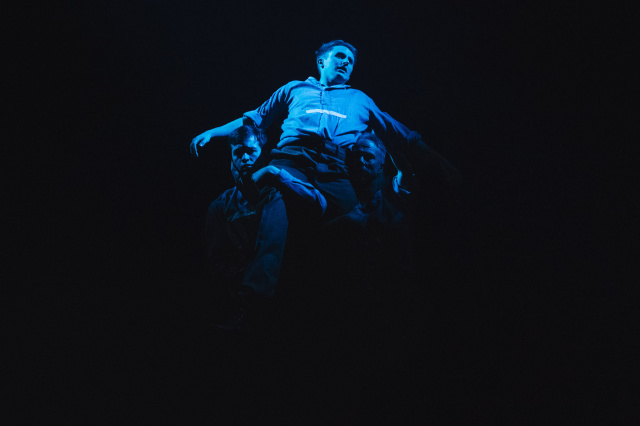
Lighting effects: “Am I drowning…?”
Oliver Tapp as Jim pitched into the sea, Charlie Veitch, Marc Opitz
Photo Steven Mitchell Wright, Theatre Works 2025
The learning curve
Learning curves are by common usage supposed to be steep. In my case, as a first time playwright working with a professional company, it turned out to be almost perpendicular.
In the eight weeks or so leading up to the opening night on 21 June, and in the two weeks of performance that followed, I learned so much about the business – the dos and the don’ts – and became so reinvigorated, that I feel fully 50 years younger. Having turned 83 in late May, it’s almost as if I could reverse the numbers!
The main thing is to have a set of very broad shoulders. The first fortnight in the rehearsal room was spent on script development, as the actors and director Beng Oh worked through the text line by line and scene by scene.
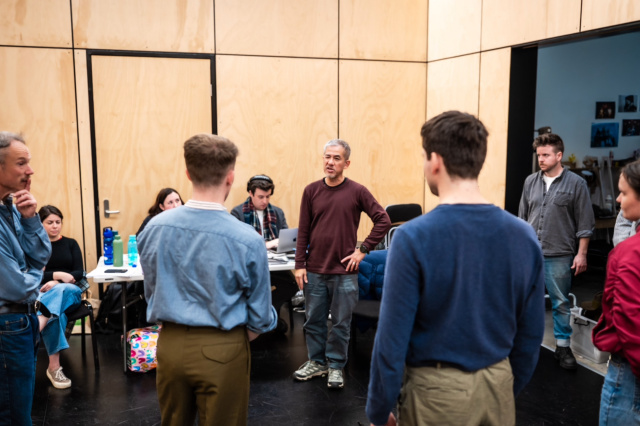
Director Beng Oh taking to cast and crew in the rehearsal room
Photo Steven Mitchell Wright, Theatre Works 2025
It quickly became apparent that there were many superfluous words – perhaps necessary in a novel that depends on descriptive passages, but not in a play where emotion is far better conveyed by the actors. They have, after all, invested so much of themselves understanding the background and motivations of the characters they’re playing.
So, not just lines but sometimes parts of scenes were cut to maintain the flow of the action or concentrate attention on the main storyline. Subplots, which may have an important role on the screen, are less so in the live theatre.
In the case of Soldier Boy, a lot of the dialogue I’d written towards the end of the play was dropped altogether. I’d used parts of the letters written home by Jim, and after his death by his best mate and the hospital ship matron who was with him when he died. As the rehearsals developed, the thought arose among the cast: Why not use the letters in their entirety – to let the real people speak for themselves?
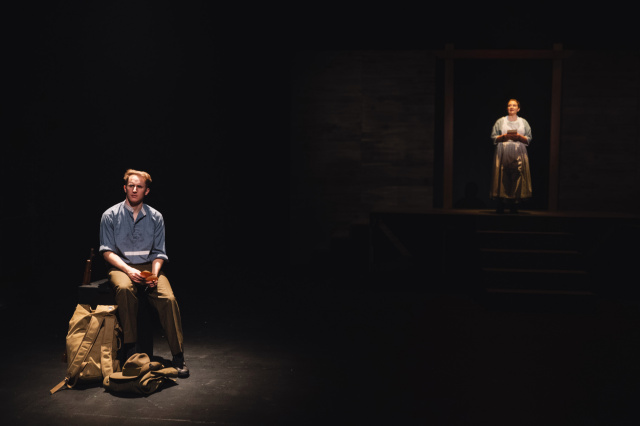
“Dear Mum and Dad…”
Laura Iris Hill, Oliver Tapp. Photo Steven Mitchell Wright, Theatre Works 2025
So theatrically effective was this, that it became incorporated into the acting text. My dialogue for this section was dropped, and the last scene where the parents begin in grief and end in recrimination was reduced to the single line “I will never forgive you, or myself.“ It was very dramatic, and reinforced Beng’s vision of the play.
Fortunately, I was a journalist in my younger days and am quite used to editors cutting whole slabs of copy, usually without even asking. In my literary work I have always given editors – and now directors – 95 per cent of what they want in order to keep the 5 per cent I think really should be retained.
Words are the most flexible of at forms, and we all have the best interests of the work in mind.
So it was with Soldier Boy. And I believe it was my willingness to be part of the collaborative company in the rehearsal room that led the cast and crew to invite me in whenever I chose. Both the writer and the play were all the better for it.
And in any case, the original text is always here for someone else who may want to look at it.
Tribute
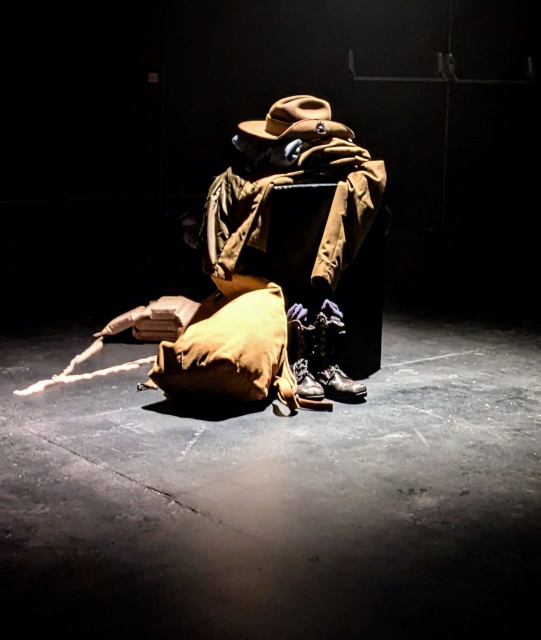
In Memoriam
Photo by Jane Tanner
I’d like to end these musings about Soldier Boy with a photo of this little memorial to Jim Martin. At the end of every performance Jim’s uniform, backpack, boots, socks and rifle – discarded as disease took hold on the young soldier – were folded by the cast acting as orderlies and placed on this plinth at the side of the stage.
It was the reverse of the image, halfway through the play, where Jim is dressed in his full uniform by those same orderlies. Oliver Tapp, who played Jim Martin with superb conviction, was a cadet at school and knew his drill. It was wonderful to see him drilling the cast doubling as soldiers in the rehearsal room. It reinforced the sense of authenticity.
When, in this midway scene he was given his rifle, Oliver performed the “reverse arms“ or “rest on arms“ mourning drill that service people do on guard at the cenotaph with heads bowed on Anzac Day , or as seen with almost every stone soldier on any suburban or country war memorial.
Every time I saw Oliver do it, my eyes welled with tears. He became not just an actor playing Jim Martin, the youngest Australian Anzac. For me, he seemed to represent every soldier who has served and sacrificed everything for their country. And the folded up clothes on their plinth as we left the theatre only served to emphasise that fact.
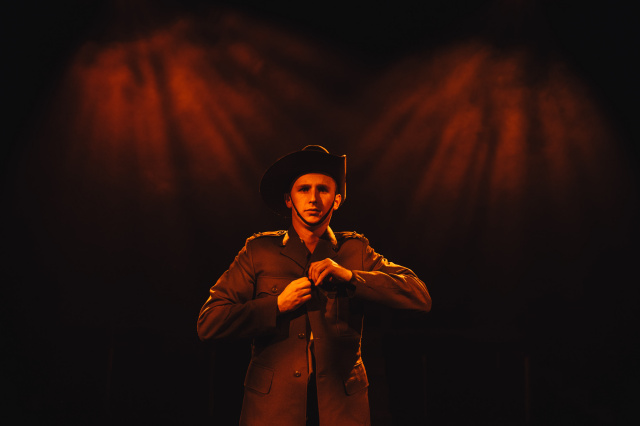
Soldier Boy.
Oliver Tapp. Photo Steven Mitchell Wright, Theatre Works 2025
Melbourne International Film Festival
The next step of course is to build on the success of this first production, and promote the play to a wider audience.
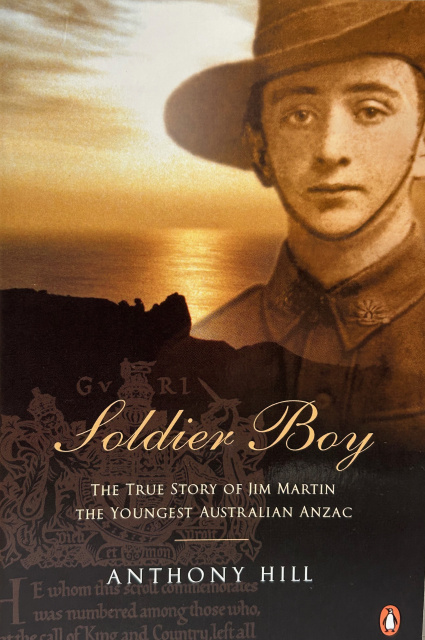 To this end, I’ve been extremely fortunate to be offered a place at the Melbourne International Film Festival (MIFF) writers’ day next month, with the opportunity to show some of my books to producers and/or directors.
The program has been arranged through the MIFF 30°South:Nexus market, which gives selected writers and other intellectual property owners up to eight 20-minute meetings with producers to pitch our work with a view to adaptations for the screen.
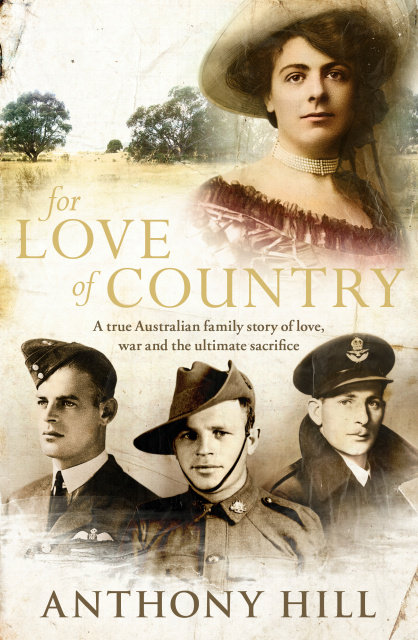
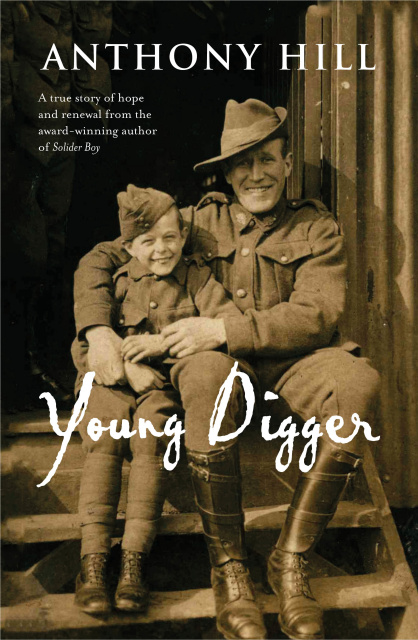 As a member of Melbourne Writers Theatre it was suggested I submit an application for a place, and it was a great honour to be informed recently that I have been accepted. I plan to pitch three of my books: Soldier Boy both book and play, the companion book and play Young Digger, and the soldier-settler saga For Love of Country which I think could make a very good television series.
 Given the success of the Soldier Boy performance and the strong reviews, I’m hoping there will be interest in the work. While some aspects of our past have fallen victim to the history wars, it remains true that interest in and appreciation of our military history continues to grow among the public at large.
The increasing crowds especially of young people at the Anzac Day matches and visits to our War Memorials and Shrines are eloquent testaments to that. We’ll see how I go at MIFF, and I’ll report any developments next time.
Acting edition
I’ve also been preparing an acting edition of the Soldier Boy play with assistance from director Beng Oh and assistant Jessica Fallico. When ready I intend to submit it to Currency Press, the main publisher of plays in this country with its significant distribution contacts within the theatrical community here and overseas. The next round of submissions is due in a couple of months.
As you may know I self-published the first version of the play, but in retrospect it would have been better to wait until after the first performance, given the changes that occurred to the final script.
Then too, I was faced with the same distribution and promotional hurdles that all self-published authors do, and to be honest this octogenarian also stumbled at them. School attendances and audience numbers were not as many as we’d hoped – and while word-of-mouth is important, given the critical success of the play I feel a fully professional publisher is the better way to go.
There’s been so much to tell about the Soldier Boy production that space in this newsletter has been quite filled up. The various literary awards that have been made so far this year, and several other items of news of interest to writers and readers, such as the continuing AI revolution and new Creative Australia initiatives, will have to be held over until the next newsletter due around January 2026.
Books in print:
Personally-signed books still in print can be ordered through the website here.
• Animal Heroes($33 plus $11.50 postage) print on demand.
• The Burnt Stick ($17.00 plus $4.50 postage).
• Captain Cook’s Apprentice($33 plus $11.50 postage) print on demand.
• The Investigators($33 plus $11.50 postage).
• The Last Convict($33 plus $15.65 postage).
• The Story of Billy Young ($23 plus $11.50 postage) print on demand.
• Soldier Boy($20 plus postage $4.50).
• Soldier Boy The Play($21.50 plus postage $4.50)
• Young Digger($30 plus postage $11.50).
I will refund any excess postage if multiple books are purchased.
Books out of print:
I have a very few copies left of some of my older titles that are now out of print. They include Antique Furniture in Australia; Growing Up & Other Stories; River Boy; and a couple of Harriet and Spindrift. If readers are interested in any of them, please contact me directly at anthony@anthonyhillbooks.comand I’ll let you know prices, postage and payment.
The next Newsletter will be the Summer 2026 edition.
With every good wish
Anthony
Photo credits:
Soldier Boy the play photographs by Steven Mitchell Wright, courtesy Theatre Works; Soldier Boy’s tribute, Jane Tanner.
www.anthonyhillbooks.com
